

Cricket
Guest curator Tony Clews takes time out of a game to explain the role of cricket in Australian Deaf sports history.
Cricket has been the oldest and longest-running organised sport played by Australian deaf people. The first deaf cricket clubs formed in the 1880s and have continued since then. This story shows some of the photos, documents and films that have been part of the Australian Deaf Cricket story.
Cricketers love statistics, and we include some of those too!
With thanks to Tony Clews and Julian Walsh for their help with this story.
1894
First Interstate Match
The first interstate Deaf cricket match was held between Victoria and South Australia, in Adelaide in 1894. Although we don’t have photographs of this match, we have the scores! This summary has been made from the original record.
1889
In 1889, the Deaf Mutes Cricket Club in Melbourne held a “Grand Variety Entertainment” to raise funds from the general public – this is the program. Some of the entertainment was provided by hearing people, such as singing, piano playing and reciting poems. Deaf people performed “living statues” and a deaf magician performed lots of conjuring tricks.

1900
Melbourne Deaf Cricket Club
The Melbourne Deaf Cricket Club, established in 1881, was one of the world’s earliest Deaf Sports Clubs. Let us know if you can help with the names.

1904
The Adelaide Deaf Mute Cricket Club was playing in local competition in the 1904-05 season. This Programme card lists the teams they played against, with space to enter the scores.

1908
William Tyzzer, a young deaf boy from Melbourne, points to the scoreboard showing the result.

1910
Adelaide Deaf Cricket Team, 1910. Let us know if you can help with the names.

1919
This interstate match was played between South Australia and New South Wales, 29 and 30 December, 1919. New South Wales won by 1 run.
The photograph shows the South Australian team:
Standing: D. Dollman (umpire), H. Blackmore (scorer), A. Rankine, A. Maggs (scorer), J. Juncken, R. Crouch, A. Simons, O. R. Redman (umpire)
Seated: F. Lehman, H. Parnell, C. McRae (capt.), A. Hann (v. capt.), W. Abbott (Ass. Secy.), P. Simpson
Front: H. Langley, R. Hindes

1894-1922
The "Pioneers"
The “Pioneers” are the teams that played before the Abraham Shield competition began in 1923.
This is an overview of all the interstate games played by the Pioneers. The full record also includes the scores of each game.
1920s
Adult Deaf Cricket Team, Melbourne, 1920s. In the back row are two of the Muir brothers. In the front row, J. M. Johnston is 2nd from right. Can you help with the other names?

1922
NSW Cricket Team’s Visit to Adelaide, 1922. Do you recognise any of the players?

An Interstate Match
This early film shows a gathering of players and spectators for a cricket match in Melbourne, between the Victorian team and another unidentified team. In the opening frames, Ernest Abraham can be seen among the crowd fingerspelling and signing “ [NAME OF CLUB?] WISH YOU ALL A HAPPY NEW YEAR!”
1927, 1928
From right to left: H. Emerson, A. Fairweather Sr., A. Bridgen, unknown, W. Kitchen, S. Bath, H. Nathan, H. Brownbell, N. McNevin, J. Chambers, S. Phillips, W. Little, unknown, Jack Valentine, J. Barrow, E. Quinnell, A. O’Callaghan.

1928
A cricket carnival was held in Tasmania for the first time at Christmas 1928. This photo shows the group of players and spectators at New Norfolk near Hobart.

1928
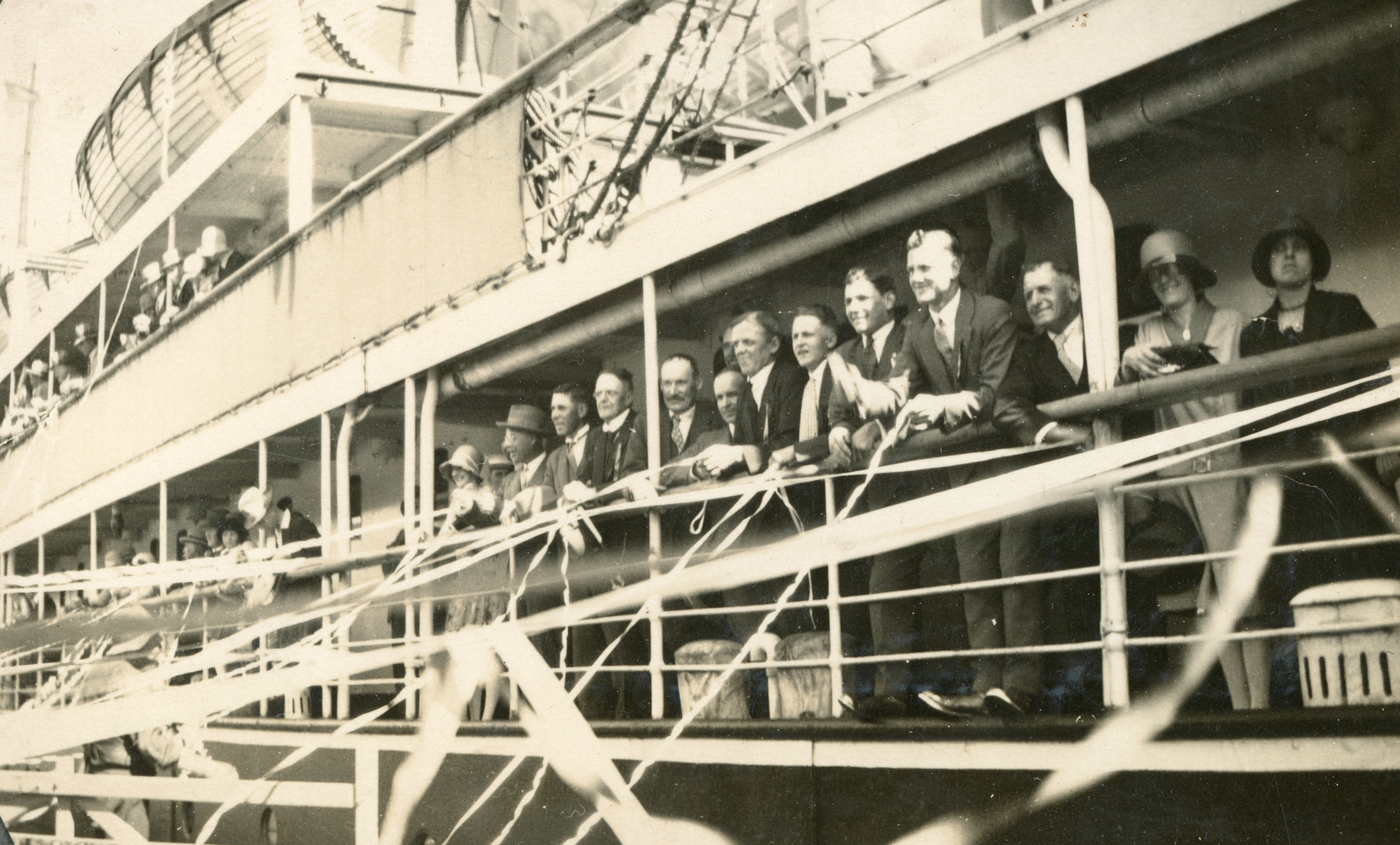
This photo shows some of the Victorian travellers on the boat leaving Melbourne for the Cricket Carnival in Tasmania.
1928
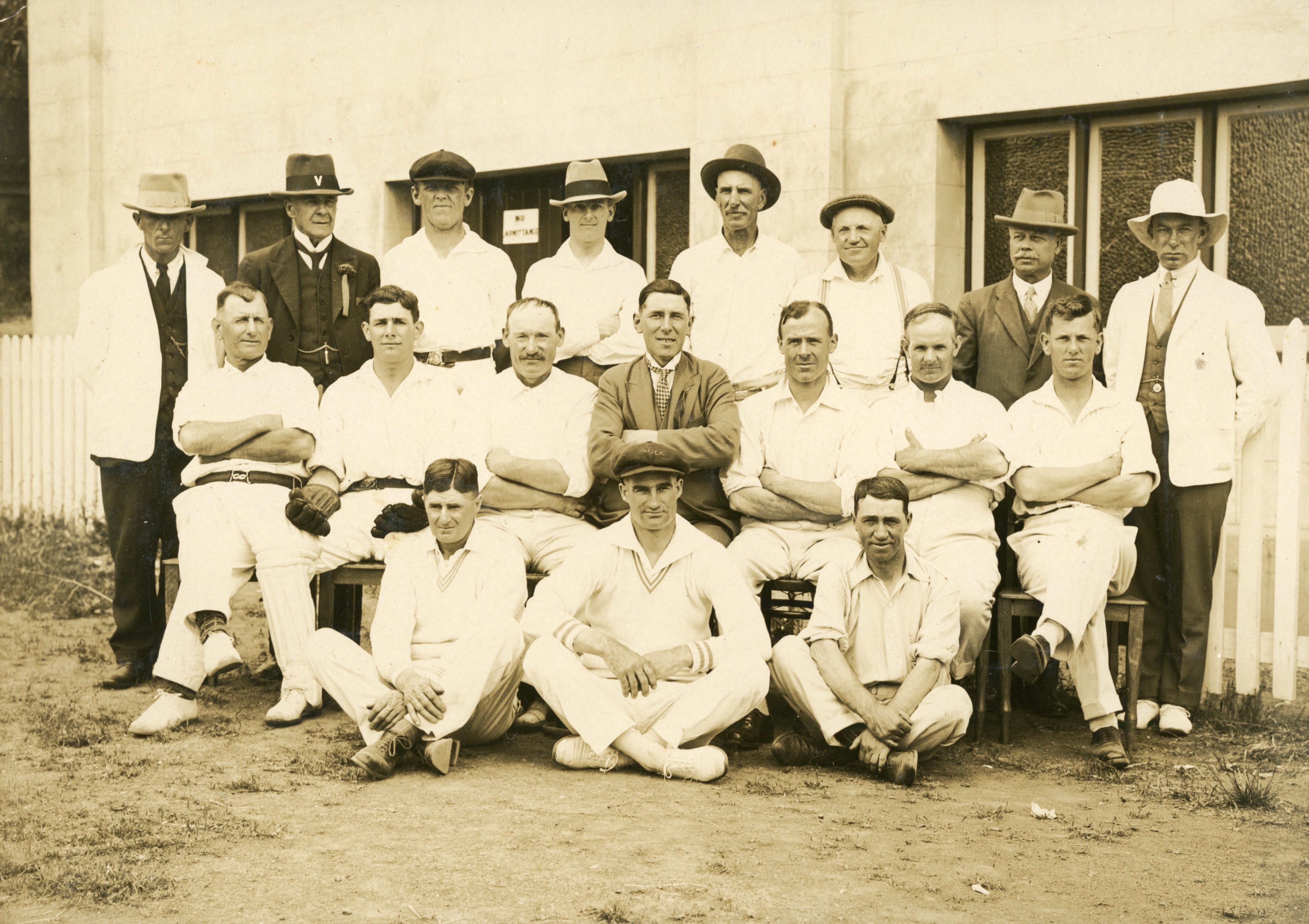
The Victorian team for the Cricket Carnival in Hobart, Christmas 1928.
In the back row, Ernest Abraham is 2nd from right.
In the middle row, J. M. Johnston (manager?) is seated in the middle.
Let us know if you can help with the other names.
1960
Local Sydney Competition
Back row, L to R: Ron Edwards, Jeff Moir, John Ravlich, Pam Munson (scorer), Reg Cuthbert, Paul Briscoe, Keith Southwell
Front row, L to R: Ralph Hughes, John Mooney, Ron Woods, Jack Christie (captain), Bob Herman.

Australia did not send a team to international cricket competitions until 1972. However before that, they would always select an Australian team based on the top performances at the Abraham Shield competition in the Australian Deaf Games. This list shows the Australian XII for 1968.
1976-77
The Abraham Shield was donated by Ernest Abraham, Superintendent of the Adult Deaf and Dumb Society of Victoria, in 1923. Australian deaf cricket teams continued to compete for the Abraham Shield until around 2000, when it was agreed that it was time for a change. Since then, they have competed for the Webby Cup.
Do you have a better photo of the Abraham Shield?

1976-77
Bill Driscoll (South Australia) was Secretary of the Australian Deaf Cricket Association for 19 years, and had a detailed knowledge of all the rules of cricket. Here he explains some of the finer points to Bruce Muller (L) and John Lovett (R).
1985-86
At the end of the Australian Deaf Games, each sport submits a summary of the points their state teams have achieved in the competition. The points for all the sports are added up to determine the overall winning state. This is the hand-written summary of the points for cricket at the XIII Australian Deaf Games in 1985-86.
1986-87
The “Silent Warriors” was the name of the Deaf cricket team playing in local Sydney competition (Ryde district) in the late 1980s. They changed their previous team name to remove the word “Deaf”, due to negative comments from the other teams. This was the Silent Warriors’ score book during the 1986-87 season.

1992
Australian Deaf Cricket Team
This was the Australian Deaf Cricket Team for the first test series against England – the “Deaf Ashes”. The English team came to Australia for this first series.


1994
This is a summary of the results from the 2nd test series against England, when the Australian team played in England. Australia won the “Deaf Ashes” 2-0, with Chris Ashenden (Aust.) being named the Man of the Series.
Read more
Bremner, A. (1996). Deaf sports in Australia. Masters thesis, La Trobe University, Melbourne.
