

National Deaf Organisations
Curator Dr Breda Carty introduces the largely forgotten history Australia’s early national deaf organisations.

The Australasian Deaf and Dumb Association
The first national association.
1903-1904
The Australasian Deaf and Dumb Association (ADDA) was established at the first national ‘Congress’ in Melbourne, in December 1903-January 1904.
This was the Programme booklet for the Congress.
1900s
The ADDA published this small booklet of “Rules”, which was similar to a Constitution.
On p. 1 they have a list of “Objects”, beginning with:
“To unite the deaf and dumb and all interested in their welfare.”
This was the ADDA’s logo. The Latin phrase can be translated as “To educate and elevate”.

1911
Australasian Deaf and Dumb Association Congress
Samuel Showell was involved in the Australasian Deaf and Dumb Association, and attended their 1911 Congress in Melbourne. Check out the full program below to find Showell’s presentation about employment of deaf people (p. 4).
The ADDA held another Congress at the end of 1911. You can read the program of activities and presentations here. Almost all hosts and presenters were deaf, and most of the topics they discussed still look relevant today.
1922, October
By the 1920s, the ADDA was declining. At a conference in Sydney, a group of hearing and deaf men discussed the purpose and future of ADDA. This photo shows some of those who were present.
(We think the man second from the right in the back row is Jim Johnston. Can you identify any others? Let us know!)

1922, October
“…they have pledged themselves to keep their eyes open for any injustice or oppression that may be placed upon the Deaf at large, and make every effort to alleviate such…this Association will assert their rights and try to secure their just claims to citizenship.”
Robert Luff, 1922 - describing the role of the ADDA
1922, October
This is the record of the meeting held in Sydney in 1922. It is an interesting account of the views of several key people (e.g., Fletcher Booth, Robert Luff, James Johnston, Samuel Showell – all deaf; and hearing men who had prominent roles in the Deaf Societies, such as Ernest Abraham, Alfred Lonsdale and others.
The Australian Association for the Advancement of the Deaf
The national association formed by members of breakaways from the Deaf Societies.
1931
Circular Letter
By the early 1930s, many deaf people were becoming restless and ready to consider a national organisation again. This circular was distributed by two NSW deaf leaders in 1931.
1931
“…the time has evidently come for the deaf to get together to exchange ideas and to try and form a common policy for the recognition of their rights.”
Fletcher Booth and Ernest Quinnell
1930s
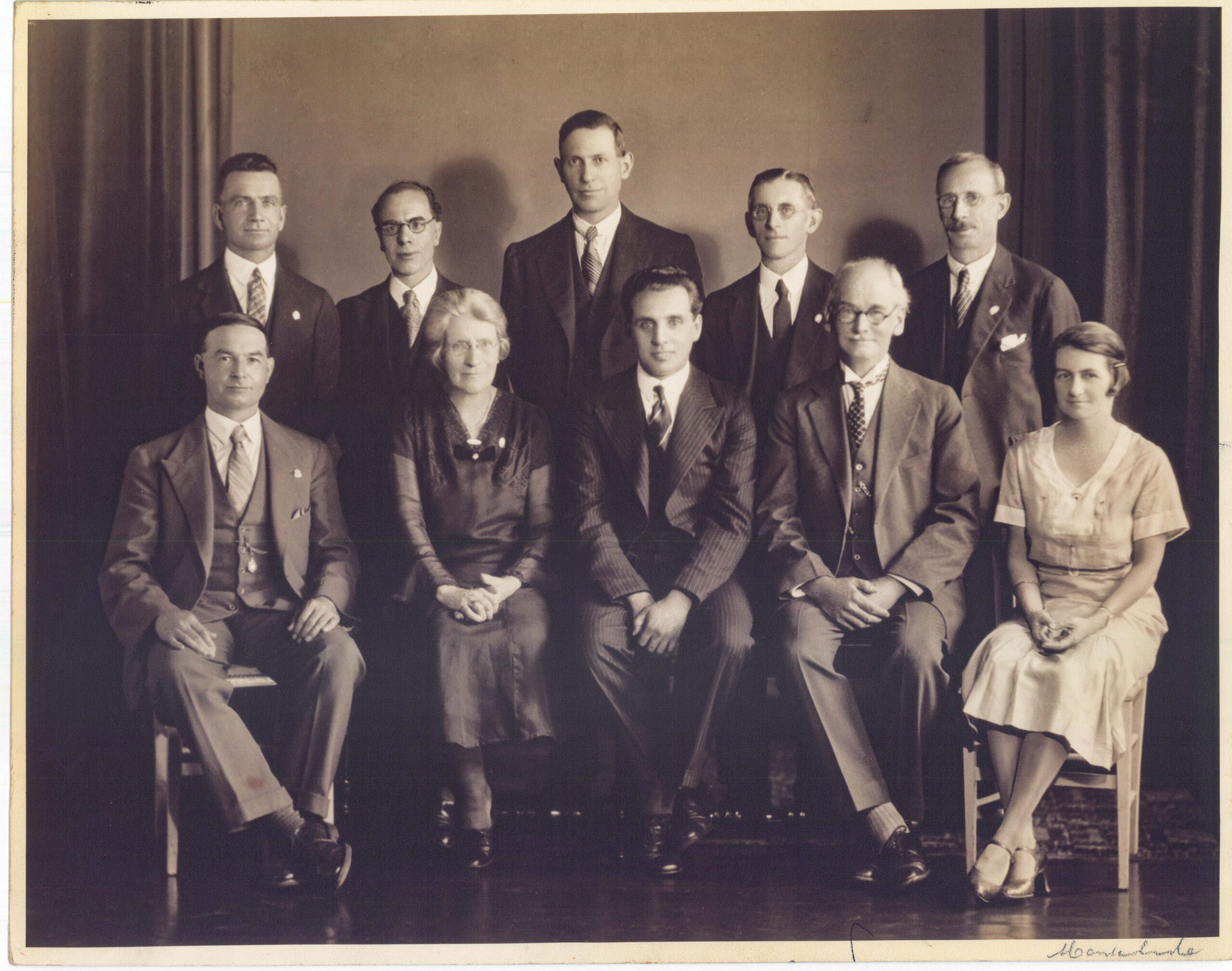
The Australian Association for the Advancement of the Deaf (AAAD) was formed at a meeting in Sydney in 1932. This was their first Council. All of them were deaf except John Paul and Herbert Hersee, and the Council included two deaf women. Standing (L to R): Ernest Quinnell (NSW), R. H. Lambert (Vic), J Allardice (Qld), John Paul (Qld, G. D. Harrison (Qld). Seated (L to R): William Crush (Vic), Martha Overend Wilson (Qld), Herbert Hersee (NSW), Fletcher Booth (NSW), Isabel Winn (NSW).
This is the text of a presentation given by Alf Eaton, a deaf man from Queensland, at an AAAD congress in Sydney in 1933. It is a very forthright description of the role of a national Deaf organisation, especially in an environment where it faces opposition (e.g., from the Deaf Societies of the time).
1933
“Every difficulty, wrong, injustice, loss or harm that comes to any deaf person is the business of all of us.”
Alf Eaton
1933
The first annual report of the Australian Association for the Advancement of the Deaf.
1932
AAAD Constitution
This was the Constitution developed by AAAD. It is interesting to see how they defined their membership (who could join and who they represented), and compare this to other national deaf organisations over time.
The National Council of the Deaf
The national organisation established by the Deaf Societies.
1934, December
NCOD Proposed Constitution
This proposed constitution was for the organisation established by Deaf Societies in opposition to the Australian Association of the Advancement for the Deaf. It was usually known as the National Council of the Deaf (NCOD). Deaf people such as Frank Frewin are listed as members of the Council. While deaf people in NSW and Queensland had to choose between their Deaf Society and the local breakaway, Victoria never had a breakaway. It is interesting to speculate where the loyalties might have been in Victoria, had there been a choice to make. It is unclear whether this constitution was ever adopted.
1930s
Hostilities between the AAAD and the National Council increased. This circular was distributed to AAAD members by Martha Overend Wilson of Queensland in 1936 or 1937, calling for “unity” amidst the conflict.

Considering the question in 1977 and 1983.
1977, January
At the Australian Deaf Games in Adelaide, 1977, there was a meeting of deaf leaders to “consider the formation of a national body of the deaf.” This group agreed – almost unanimously – that it would not be a good idea to set up a national deaf organisation at that time. They seemed to prefer to let the Deaf Societies represent them, and were concerned about possible conflict with the Deaf Societies.
1983, January
This gathering was at the Australian Deaf Games in Melbourne – this time the deaf representatives agreed it was time to set up a national body, and elected a Steering Committee
1986
The Australian Association of the Deaf is formed in 1986.
1986, June
This is the record of the meeting at which AAD was established in 1986.


